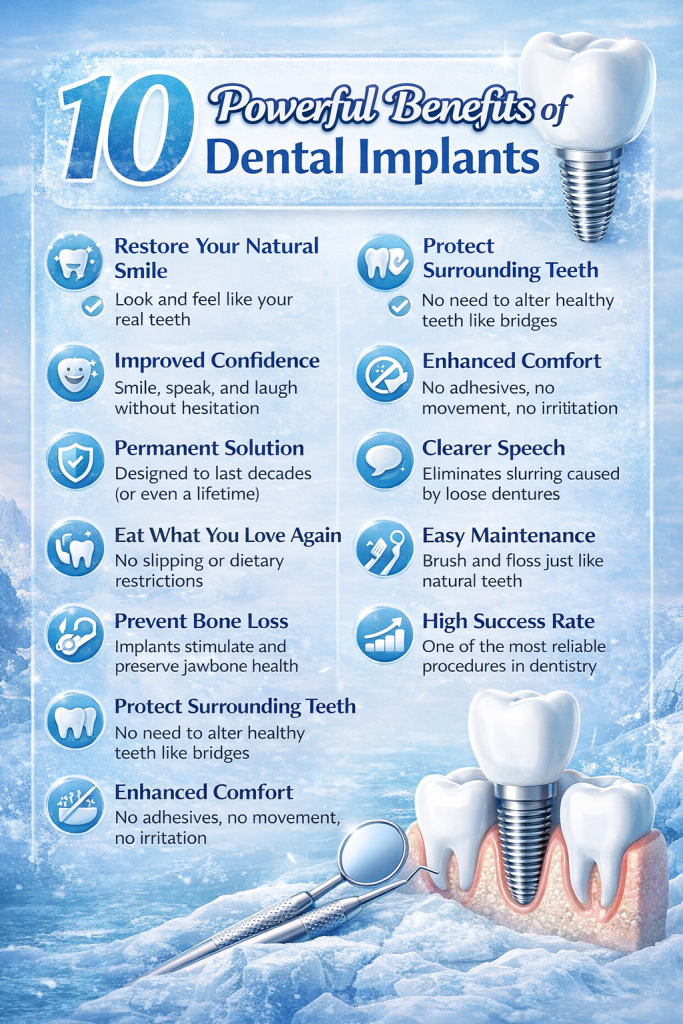
10 Benefits of Dental Implants in Parma, OH

Why Dental Implants Change Lives
Losing a tooth changes more than your smile—it changes how you eat, how you speak, how you feel about yourself, and even the structure of your face over time. While dentures and bridges have helped people cope with tooth loss for generations, dental implants offer something fundamentally different: a permanent replacement that looks, feels, and functions like the natural tooth you lost. For patients throughout Parma and Greater Cleveland considering their tooth replacement options, understanding the unique benefits of dental implants helps explain why so many people consider them the gold standard in modern dentistry.
At Glacial Dental, Dr. Michael Alsouss, DDS provides comprehensive dental implant services that restore not just missing teeth but quality of life. Implants have transformed the lives of countless patients—allowing them to eat foods they’d given up, smile without self-consciousness, and forget they ever lost a tooth in the first place. If you’re weighing your options for replacing missing teeth, these ten powerful benefits reveal why dental implants deserve serious consideration.
The 10 Life-Changing Benefits of Dental Implants
Benefit 1: Implants Look Completely Natural
When dental implants are done right, no one can tell you have them—including you. The crown that attaches to your implant is custom-crafted to match the color, shape, size, and translucency of your surrounding natural teeth. It emerges from your gum line exactly as a natural tooth would, without the telltale signs that give away other restorations.
Unlike dentures that can look artificial or bridges that connect multiple teeth together, each implant stands alone as an individual tooth. The ceramics used for implant crowns mimic the light-handling properties of natural enamel, creating depth and realism that older restoration materials couldn’t achieve. When you smile, laugh, or speak, your implant blends invisibly with your natural teeth.
This natural appearance extends beyond aesthetics to psychology. Patients with implants report feeling whole again—not like someone with “false teeth” or dental work, but simply like someone with teeth. That psychological benefit shouldn’t be underestimated.
Benefit 2: Implants Feel Like Your Own Teeth
Because implants are anchored in your jawbone just like natural tooth roots, they feel remarkably like the real thing. There’s no awareness of something foreign in your mouth, no appliance resting on your gums, no clicking or shifting when you talk or chew.
Once your implant has healed and integrated with your bone—a process called osseointegration—it becomes a permanent part of your anatomy. The crown attached to it has the same size and shape as a natural tooth, so your tongue, lips, and cheeks interact with it normally. Many patients forget which tooth is the implant after a while; it simply feels like their own.
This natural sensation contrasts sharply with removable dentures, which patients always remain aware of, and even with bridges, which connect teeth in ways that can feel different from natural tooth arrangements.
Benefit 3: Implants Restore Full Chewing Power
One of the most dramatic benefits of dental implants is the restoration of complete chewing function. Because implants are rooted in bone, they provide the same stable foundation that natural teeth do. You can bite and chew with full force, eating anything you want without restriction.
Denture wearers often struggle with certain foods—corn on the cob, apples, steak, crusty bread, raw vegetables. The dentures simply don’t provide enough stability for aggressive chewing. Bridge patients may be advised to avoid very hard or sticky foods. Implant patients face no such limitations. If your natural teeth could handle it, your implant can too.
This restoration of eating ability isn’t just about enjoying your favorite foods (though that matters). It’s about nutrition. When people can’t chew properly, they tend to avoid healthy foods that require thorough chewing—like fresh fruits, vegetables, and lean proteins—in favor of softer, often less nutritious options. Implants let you eat the balanced diet your body needs.
Benefit 4: Implants Prevent Bone Loss
This benefit is one of the most important yet least understood advantages of dental implants. When you lose a tooth, the jawbone in that area begins to deteriorate because it’s no longer receiving stimulation from a tooth root. This process, called resorption, continues indefinitely—the bone literally shrinks away over time.
Dental implants are the only tooth replacement option that prevents this bone loss. The titanium implant post integrates with your jawbone and stimulates it just as a natural root would. The bone remains healthy and maintains its density, preserving your jaw structure for life.
Why does this matter? Bone loss affects more than just the area of the missing tooth. As the jawbone shrinks, neighboring teeth lose support and may become loose or shift. Facial structure changes as bone diminishes—the lower face can appear collapsed or sunken, lips may thin, and wrinkles may deepen. These changes can make you look years older than you are. By preserving bone, implants preserve your facial structure and your youthful appearance.
Benefit 5: Implants Protect Your Remaining Natural Teeth
Traditional bridges require grinding down the teeth on either side of a gap to serve as anchors for the replacement tooth. These healthy teeth must be permanently altered—stripped of their natural enamel—to support the bridge. Once this preparation is done, those teeth will always need crowns, even if the bridge eventually fails.
Dental implants stand completely independent of neighboring teeth. The implant post goes into the bone where the missing tooth’s root used to be, and the crown attaches to that post. Adjacent teeth are never touched. If those neighboring teeth are healthy and intact, they stay that way.
This independence also prevents the shifting that commonly occurs when teeth are missing. Without something filling the gap, neighboring teeth tend to drift toward the empty space, and opposing teeth may over-erupt. Implants maintain proper spacing and prevent this domino effect of dental problems.
Benefit 6: Implants Are Permanently Fixed in Place
Unlike dentures that must be removed for cleaning and sleeping, dental implants are permanently fixed in your mouth. They don’t come out—ever. You care for them exactly as you care for natural teeth: brushing, flossing, and regular dental checkups.
This permanence eliminates the daily hassles associated with removable dentures: the adhesives, the soaking solutions, the embarrassment of removing teeth at night, the anxiety about dentures slipping at inopportune moments. Implants are simply there, all the time, functioning as part of your body.
For patients who’ve struggled with loose or ill-fitting dentures, implants can also provide a permanent solution through implant-supported dentures. Rather than resting on gums and relying on suction, the denture snaps securely onto implants, providing stability that traditional dentures can’t match.
Benefit 7: Implants Are Extremely Durable and Long-Lasting
Dental implants are designed to last a lifetime. The titanium post, once integrated with your bone, typically remains permanently stable. While the crown attached to the implant may eventually need replacement due to normal wear—usually after 15-20 years—the implant itself can serve you for the rest of your life.
Compare this longevity to other options. Bridges typically last 10-15 years before needing replacement. Dentures may need replacement every 5-10 years as your mouth changes shape due to bone loss. When you factor in the cost of repeatedly replacing these restorations over a lifetime, the initial investment in implants often proves more economical in the long run.
The durability of implants also means fewer dental visits for repairs and replacements, less time in the dental chair, and more years of simply enjoying your teeth without thinking about them.
Benefit 8: Implants Are Easy to Care For
Caring for dental implants requires no special products, complicated routines, or extra steps. You simply brush twice daily, floss once daily, and see your dentist for regular cleanings and checkups—exactly what you should do for natural teeth.
There are no denture adhesives to apply, no special cleaning solutions to buy, no soaking required, no appliances to remove and store. Your implant is part of your mouth, and you care for it as part of your normal oral hygiene routine.
This simplicity is particularly valuable as we age. Complex dental care routines become more difficult to maintain as dexterity decreases or memory issues develop. The straightforward care that implants require remains manageable throughout life.
Benefit 9: Implants Support Clear, Natural Speech
Missing teeth and ill-fitting dentures can significantly impact speech. Gaps from missing teeth can cause whistling or lisping. Dentures that slip or shift change the position of your tongue and can make certain words difficult to pronounce clearly. Many denture wearers develop a “denture voice” or speak more cautiously to avoid embarrassing slippage.
Dental implants restore the tooth structure your tongue and lips need to form sounds correctly. Because implants are fixed and stable, there’s no slipping or movement to worry about. You speak naturally, confidently, and clearly—just as you did with your natural teeth.
For professionals whose careers depend on clear communication—teachers, salespeople, executives, performers—this benefit alone can justify the investment in implants.
Benefit 10: Implants Boost Confidence and Quality of Life
Beyond all the physical benefits, dental implants deliver something harder to quantify but profoundly important: confidence. Patients with implants consistently report improvements in self-esteem, social comfort, and overall quality of life.
When you’re not worried about your teeth—not wondering if your dentures will slip, not hiding your smile because of gaps, not avoiding certain foods in social situations—you’re free to focus on living your life. You smile freely in photos. You laugh without covering your mouth. You order what you want at restaurants. You speak up in meetings without self-consciousness.
These improvements ripple through every aspect of life. Studies have shown that people who feel good about their smiles are perceived as more attractive, more successful, and more confident by others. Implants don’t just restore teeth; they restore the confidence to fully engage with the world.
Our Step-by-Step Dental Implant Process
Understanding the implant process helps you know what to expect and feel confident about moving forward.
Step 1: Comprehensive Consultation
Your implant journey begins with a thorough evaluation. Dr. Alsouss examines your mouth, reviews your dental and medical history, and takes digital X-rays and 3D cone beam images to assess your bone structure. He discusses your goals, explains your options, and determines whether implants are right for your situation.
Step 2: Treatment Planning
Using your imaging results, Dr. Alsouss develops a detailed treatment plan. He determines optimal implant placement, identifies any preparatory procedures needed (such as bone grafting), and maps out your complete timeline from surgery through final restoration.
Step 3: Preparatory Procedures (If Needed)
Some patients require bone grafting to build up adequate bone for implant placement. If needed, this procedure is performed and given time to heal—typically several months—before implant surgery proceeds.
Step 4: Implant Placement Surgery
The implant post is surgically placed into your jawbone. This procedure is performed under local anesthesia with sedation available for anxious patients. Most patients report the procedure is more comfortable than they expected, with less discomfort than a tooth extraction.
Step 5: Osseointegration (Healing Period)
Over the next three to six months, your jawbone grows around and bonds with the titanium implant post. This integration is what gives implants their remarkable stability. During this time, you may wear a temporary restoration so you’re never without teeth.
Step 6: Abutment Placement
Once osseointegration is complete, a small connector piece called an abutment is attached to the implant. This provides the attachment point for your final crown. A brief healing period follows.
Step 7: Crown Placement
Finally, your custom-crafted permanent crown is attached to the abutment. Dr. Alsouss verifies fit, bite, and appearance, making any final adjustments. You leave with your completed restoration—a new tooth that will serve you for decades to come.
Expert Dental Implant FAQ
Are dental implants painful?
Most patients are surprised by how comfortable the implant process is. The surgery itself is performed under local anesthesia, so you feel nothing during the procedure. Post-operative discomfort is typically mild to moderate—often less than after a tooth extraction—and well-controlled with over-the-counter pain medication. Most patients return to normal activities within a day or two.
How long do dental implants last?
The implant post itself—the titanium piece placed in your bone—can last a lifetime with proper care. The crown attached to the implant typically lasts 15-20 years before needing replacement due to normal wear. This makes implants the longest-lasting tooth replacement option available.
Am I a candidate for dental implants?
Most adults with missing teeth are candidates for implants. You need adequate jawbone to support the implant (or willingness to undergo bone grafting), healthy gums, and overall health sufficient for minor surgery. Certain conditions like uncontrolled diabetes or heavy smoking can affect implant success. Dr. Alsouss evaluates each patient individually to determine candidacy.
How much do dental implants cost?
Implant costs vary based on how many implants you need, whether bone grafting is required, and other factors specific to your case. While the upfront cost is higher than bridges or dentures, implants often prove more economical over a lifetime because of their durability. We provide detailed cost estimates during your consultation and offer payment options to make implants accessible.
What’s the success rate of dental implants?
Dental implants have a success rate exceeding 95%—among the highest of any surgical procedure. Success rates are even higher for healthy non-smokers with good oral hygiene. When implants do fail, it’s usually within the first year; implants that successfully integrate with bone rarely fail later.
Can dental implants replace multiple teeth?
Absolutely. Single implants replace individual teeth. Implant-supported bridges replace several adjacent teeth using implants at each end of the span. For patients missing all teeth, as few as four to six implants can support a full arch of teeth—a solution often called All-on-4. Implants are versatile enough to address virtually any tooth loss situation.
How do I care for dental implants?
Care for implants just as you would natural teeth: brush twice daily, floss daily, and see your dentist for regular checkups and cleanings. There are no special products or routines required. Good oral hygiene protects the gum tissue and bone around your implant, ensuring long-term success.
What happens if I don’t replace a missing tooth?
Leaving a gap has consequences that compound over time. Adjacent teeth shift toward the empty space. Opposing teeth may over-erupt. Bone loss occurs in the area of the missing root. Chewing function decreases. Facial structure can change. The longer you wait to replace a missing tooth, the more complicated and expensive treatment becomes. Addressing tooth loss promptly protects your oral health and simplifies restoration.
Experience the Life-Changing Benefits of Dental Implants
Missing teeth don’t have to limit your life. Dental implants offer a permanent solution that looks natural, feels natural, and restores complete function—benefits no other tooth replacement can match. From preserving your bone and protecting neighboring teeth to restoring your confidence and quality of life, implants deliver advantages that last a lifetime.
Dr. Michael Alsouss, DDS provides expert dental implant services for patients throughout Parma and Greater Cleveland. Using advanced imaging technology and proven techniques, he helps patients rediscover the joy of a complete, healthy smile.
Ready to learn whether dental implants are right for you? Schedule an appointment for your implant consultation and take the first step toward the permanent tooth replacement you deserve. Have questions? Please contact us—we’re happy to help you explore your options.
Glacial Dental
5500 Broadview Rd
Suite 100
Parma, OH 44134